
Welcome Offer: 15% Off Your First Purchase
Best Whisker-Friendly Cat Bowl: How Bowl Design Can Make Mealtime More Comfortable

Does Your Cat Need a More Whisker-Friendly Cat Bowl?
Have you ever noticed your cat taking food out of its bowl and eating it from the floor? Or perhaps your cat seems perfectly happy eating from a flat plate but becomes hesitant when using a deep, narrow bowl.
These behaviors can have several explanations, but the shape of the feeding bowl is one factor worth considering.
A cat’s whiskers are highly sensitive sensory structures that help it gather information about its surroundings. When a bowl is too narrow or deep, the whiskers may repeatedly brush against its sides as the cat reaches for food.
Some cats appear sensitive to this repeated contact and may prefer a bowl that gives their face more room.
This is why many pet parents search for a whisker-friendly cat bowl or a cat bowl for whisker sensitivity.
Rather than choosing a bowl based on appearance alone, it makes sense to consider its opening width, depth, inner shape, and ease of cleaning.
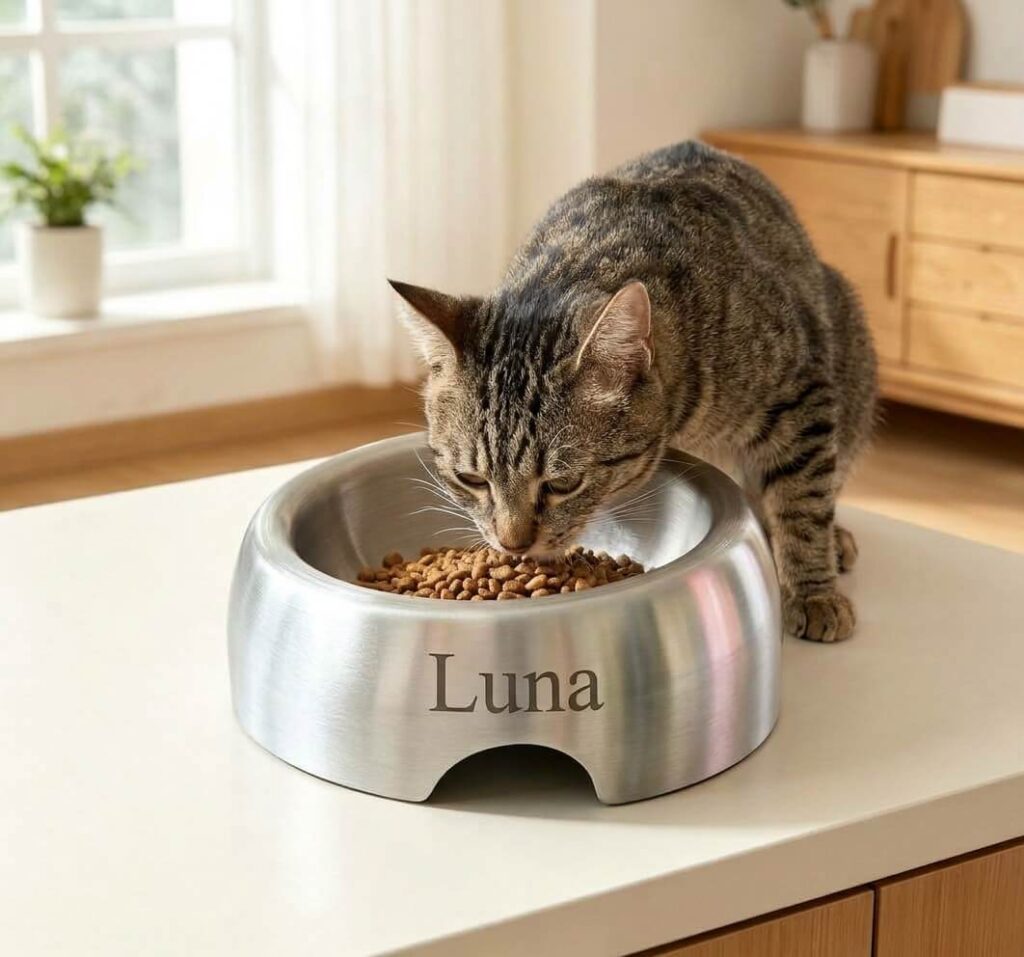
Our angled 304 stainless steel pet bowl is designed with these everyday needs in mind: a wide 16.5 cm opening, a gently sloped feeding surface, and a smooth, seamless interior.
The result is a practical feeding solution designed to make food easier to reach and daily bowl care simpler.
1. Whisker Fatigue: Why Some Cats Prefer a Wide Cat Bowl
What is whisker fatigue?
The term whisker fatigue is commonly used by pet owners to describe suspected discomfort associated with repeated whisker contact during feeding or drinking.
However, it is important to distinguish a popular term from an established veterinary diagnosis. Scientific evidence that ordinary bowl contact consistently causes a distinct medical condition remains limited.
What we do know is that cat whiskers, also known as vibrissae, are specialized sensory hairs connected to sensitive structures in the skin. They help cats detect nearby objects and navigate their environment.
For some cats, repeated contact with a narrow container may be bothersome. Others may have no difficulty eating from a conventional bowl at all.
Signs your cat may prefer a different bowl
You might notice that your cat:
- Removes pieces of food from the bowl before eating them.
- Prefers eating from a flat plate or open surface.
- Leaves food around the edges instead of reaching into the bowl.
- Appears more comfortable using a wider, shallower dish.
These behaviors do not automatically mean your cat has whisker fatigue. Food preferences, bowl placement, stress, nausea, dental discomfort, and other factors can also affect eating habits.
If the behavior is new, persistent, or accompanied by reduced appetite, weight loss, drooling, or difficulty chewing, consult your veterinarian rather than assuming the bowl is the cause.
How a whisker-friendly cat bowl can help?
A wide opening gives your cat more space around its face and may reduce repeated whisker contact with the bowl walls.
Our 16.5 cm wide-opening cat bowl is designed to provide that extra room while keeping food accessible along a gently curved, angled interior.
It is particularly worth considering for cats that seem uncomfortable with narrow or deep dishes, including some cats with broader facial shapes.
The goal is simple: offer more room around the face without making mealtime unnecessarily complicated.
A note for flat-faced cats: Breeds such as Exotic Shorthairs may benefit from a bowl that accommodates their facial shape. However, every cat is different, and bowl suitability also depends on the individual animal’s size, posture, and feeding habits.
2. Can a Cat Bowl Help With Black Chin or Feline Acne?
Black spots around a cat’s chin can be concerning, especially when they resemble dirt or small blackheads.
This condition is commonly associated with feline chin acne, a skin problem that can range from mild blackheads to redness, swelling, and inflammation.
If you are searching for a cat acne bowl, it is worth understanding what a bowl can—and cannot—do.
What causes feline chin acne?
Feline chin acne is associated with abnormal follicular keratinization and can involve inflammation or secondary infection in more significant cases.
Its exact causes are not fully understood, and several contributing factors may be involved.
Bowl material alone has not been established as a universal cause of feline chin acne. Similarly, switching to stainless steel cannot guarantee that a cat will never develop black chin.
Why bowl hygiene still matters
Food residue, oils, and environmental debris can build up on feeding surfaces between washes.
Regular cleaning helps maintain a hygienic feeding area, regardless of the material used.
A bowl with a smooth, nonporous surface and minimal crevices can make this routine easier. Stainless steel is a practical choice because it is durable, corrosion-resistant, and generally straightforward to clean when properly manufactured and maintained.
Our 304 stainless steel cat bowl features a one-piece interior without the complicated seams and corners found in some multi-part designs. Its smooth surface makes everyday washing more convenient.
The bowl is also designed for dishwasher cleaning and high-temperature sanitation, subject to the manufacturer’s care instructions.
What if your cat already has black chin?
If you notice black specks on your cat’s chin, you can:
- Wash the food bowl regularly with an appropriate dishwashing detergent and rinse it thoroughly.
- Remove leftover wet food and clean visible residue after meals.
- Keep the feeding area clean and replace damaged or difficult-to-clean bowls.
- Avoid picking, squeezing, or scrubbing irritated skin.
- Ask your veterinarian to assess persistent black spots, redness, swelling, sores, or discomfort.
A clean stainless steel bowl can support good feeding hygiene, but it is not a treatment for feline acne.
The takeaway: Choose a bowl that is easy to clean, and maintain a consistent washing routine. Do not rely on bowl material alone to prevent or cure a skin condition.
3. Why an Angled Cat Bowl May Make Food Easier to Reach
The shape of a bowl influences how your pet accesses food.
In a deep, flat-bottomed bowl, food may spread across the bottom and collect along the perimeter. Depending on the animal’s facial shape and feeding posture, reaching the last pieces can require extra effort.
An angled bowl changes the presentation of the food.
Our one-piece angled pet bowl features a sloped interior and a gently curved inner wall designed to help food move toward the lower central area.
This can make food easier to gather and reach, with fewer awkward corners where small pieces may remain.
The design also allows the bowl to provide a broad opening without simply becoming a large, deep container.
For cats that prefer a more open feeding surface, this combination can be a practical alternative to conventional narrow bowls.
Keep in mind that an angled design does not suit every cat automatically. The best choice is one that lets your pet eat comfortably without excessive reaching, awkward neck positioning, or difficulty accessing the food.
4. Is an Angled Pet Bowl Suitable for French Bulldogs?
Cats are not the only pets whose facial structure can influence feeding comfort.
Small dogs, particularly short-muzzled breeds, may also benefit from a bowl that is easy to approach and does not require them to push their face deep into a narrow container.
The French Bulldog is a familiar example.
Understanding the feeding challenges of short-nosed dogs
French Bulldogs are brachycephalic dogs, meaning they have a shortened skull and muzzle. Some have brachycephalic obstructive airway syndrome (BOAS), a condition associated with narrowed airways and varying degrees of breathing difficulty.
Their facial anatomy can make certain everyday activities less comfortable, depending on the individual dog.
However, not every French Bulldog has clinically significant airway obstruction, and a feeding bowl cannot correct the underlying anatomy or treat BOAS.
Why bowl shape is worth considering
A conventional deep bowl may require a short-muzzled dog to reach farther into the container to access food.
A wide-opening French Bulldog feeding bowl with an angled interior offers an alternative: food is presented along a sloped surface, and the broad opening provides more room around the face.
Our 16.5 cm angled bowl is designed to make food easier to approach and access, particularly for appropriately sized small dogs.
Its suitability depends on the dog’s body size, snout width, eating style, and the height and angle of the bowl. Observe your dog during meals to make sure it can eat without struggling or adopting an awkward posture.
What about an elevated angled dog bowl?
An elevated angled dog bowl is not automatically better for every dog.
Bowl height should be appropriate for the individual animal. Raising the bowl does not necessarily improve digestion or breathing, and there is no basis for claiming that an angled bowl prevents respiratory problems in French Bulldogs.
If your dog coughs, gags, regurgitates, breathes noisily, or appears distressed while eating, consult your veterinarian. Dogs with known airway disease or swallowing problems may need individualized feeding advice.
For everyday use, the priority is to make food accessible while allowing your dog to maintain a comfortable, stable posture.
5. Why Choose a 304 Stainless Steel Pet Bowl?
Comfort is only part of a good feeding experience. The bowl also needs to withstand everyday use and remain easy to maintain.
Our angled pet bowl combines several practical details.
Food-grade 304 stainless steel
The bowl is made from 304 stainless steel, a durable, corrosion-resistant material commonly used in food-contact applications.
Its smooth surface is straightforward to wash and does not require the same care as some more easily scratched materials.
Actual performance depends on manufacturing quality, surface finish, and proper maintenance.
Seamless, one-piece construction
The one-piece design minimizes seams and hard-to-reach joints inside the bowl.
Fewer crevices can make cleaning easier and reduce areas where food residue may remain unnoticed.
Non-slip rubber ring
An included rubber ring helps the bowl grip the floor and reduces sliding during meals.
This is particularly useful for enthusiastic eaters who tend to push their bowls around.
The ring is removable for cleaning when the product’s care instructions permit.
Convenient finger-grip area
A small grip area underneath makes the bowl easier to lift and move during feeding-area cleanup.
Simple, modern appearance
The silver stainless steel finish fits naturally into a variety of home interiors without adding unnecessary visual clutter.
It is a practical combination of everyday function and understated design.
6. Product Specifications
| Feature | Details |
|---|---|
| Material | 304 stainless steel |
| Design | One-piece angled feeding bowl |
| Diameter | 16.5 cm / approximately 6.5 in |
| Height | 6.8 cm / approximately 2.7 in |
| Product weight | 300 g / approximately 10.6 oz |
| Included accessory | Non-slip rubber ring |
| Inner design | Gently curved, sloped surface |
| Cleaning | Dishwasher cleaning and high-temperature sanitation according to care instructions |
| Suitable pets | Cats and appropriately sized small dogs, depending on individual fit |
7. How to Choose the Right Bowl for Your Pet
Not every pet needs the same bowl. Before buying, consider the following:
For cats with suspected whisker sensitivity: Look for a wide opening that gives the face room and minimizes repeated contact with the sides.
For flat-faced cats: Check the opening width, inner shape, and how easily your cat can reach the food.
For cats prone to chin acne: Prioritize easy cleaning and consistent bowl hygiene, while remembering that acne can have multiple contributing factors.
For French Bulldogs and other short-muzzled dogs: Choose a bowl that allows comfortable access to food without requiring the dog to push its face deeply inside. Consider the dog’s size and feeding posture rather than relying on breed alone.
For pets that push their bowls around: A properly fitted non-slip ring can help reduce movement.
Most importantly, watch your pet eat. The best bowl is the one that fits its individual needs and can be kept clean with minimal effort.
Make Everyday Mealtime More Comfortable
A good pet bowl does more than hold food. Its shape determines how easily food can be reached, how much room there is around the face, and how convenient the bowl is to clean after every meal.
For cats that seem sensitive to narrow dishes, a wide-opening whisker-friendly cat bowl may be worth trying.
For pet parents concerned about black chin, a smooth, easy-to-clean stainless steel cat bowl can support a consistent hygiene routine without promising to prevent or cure feline acne.
And for appropriately sized small dogs, including some French Bulldogs, an angled feeding surface can offer a practical way to make food easier to access.
Our 304 stainless steel angled pet bowl brings these details together in one design: a 16.5 cm wide opening, a curved sloped interior, seamless construction, and a non-slip rubber ring.
More room around the face. Easier access to food. Simpler everyday cleaning.
Because better mealtime design starts with understanding what your pet actually needs.
FAQ:
1. Are wide bowls better for cats’ whiskers?
Wide bowls can reduce repeated whisker contact for cats that dislike narrow containers. Individual preferences vary, and whisker fatigue is not a firmly established veterinary diagnosis.
2. Can a stainless steel cat bowl prevent chin acne?
No bowl material can guarantee prevention. Stainless steel is durable and easy to clean, which can support good feeding hygiene, but feline chin acne has multiple possible contributing factors.
3. Are angled bowls good for French Bulldogs?
An angled bowl may make food easier to access for some French Bulldogs, depending on their size and feeding posture. It does not treat airway disease or correct brachycephalic anatomy.
4. What size cat bowl should I choose?
Consider your cat’s facial width, eating style, and the amount of food served per meal. A 16.5 cm opening provides a relatively broad feeding area, but the best size depends on the individual cat.
5. Is 304 stainless steel easy to clean?
Yes. Properly manufactured 304 stainless steel is durable, corrosion-resistant, and generally easy to wash. Follow the manufacturer’s cleaning instructions, and wash the bowl regularly.